It's What We Do
Updated: May 6
#menachot #masehetmenachot #tefillin #talkingtalmud #wordshavewings #davening #prayer #sacrifice #sacrificeandprayer
Hello Friends!
This is a week of double posts- something that I haven't done in quite a while. Because Masechet Menachot, is 110 pages, it has been a little more than 110 days since my last entry on my Daf Yomi travels. We are in year six of the seven-year cycle, and we are now beginning Masechet Chullin. (It's a good time to join in!) You can find other Daf Yomi entries
from Words Have Wings here.
A brief description of Masechet Menachot: (Tractate of Menachot)
Masechet Menachot (Meal Offerings), the second tractate in Seder Kodashim, contains 13 chapters detailing flour-based sacrifices, oil/wine libations, and priestly service (kemitzah).
It focuses on voluntary and mandatory grain offerings, including Showbread and the Omer, while also hosting major discussions on ritual items: tzitzit, tefillin, and mezuzah. (from AI)
To me, Menachot is a book of "what if's," " how-to's," complex cases, and questions. It is a book of descriptions and a plethora of details, most of which are no longer practiced, with the notable exception of tzitzit, tefillin and mezuzah.
I want to share a story with you. One morning, a few years ago someone told me that his favorite prayers were the descriptions of the sacrifices that are read each day during the Shacharit service. He said that it is the routine of getting up and showing up for prayer is the strength behind the Jewish people. It is the "dailiness," and the attention to detail that matters.
In Masechet Menachot we learned the details what the Kohanim did for various sacrifices. Fast- forward millenium and we find ourselves in houses of prayer across continents. In tiny synagogues or large synagogue, we still learn and repeat these teachings.
It’s showing up. It's what we do.
I wonder if the rabbis could foresee just how far their discussions would travel?
With blessings,
Leann
Menachot 50a-b: Daily offerings; daily incense
Two daily offerings were brought in the Temple every, single day – the tamid shel shachar and the tamid shel bein ha-arbayim (the daily morning sacrifice and the daily afternoon sacrifice). Accompanying these sacrifices was the ketoret – the incense offering – that was brought both morning and afternoon. (Orthodox Union Rabbi Adin Steinsaltz)
It's What We Do
(dedicated to WH and to Beit Sasson)
It's what we do.
It is the dailiness, the routine.
It's getting out of bed in the morning before the sun rises.
It is tiptoeing in the dark so as not to wake anyone as you dress.
It is getting into a cold car.
It is making your way, despite snow, wind or rain.
It is driving through quiet streets pre-dawn.
It is the familiar click of the door knob as you enter the building.
It is touching the mezuzah.
It is that quiet which calms you as you enter.
It is leaving one world behind for a few moments and entering to a
time dependent, yet
timeless space.
It is finding a seat, your seat, where you sit each day.
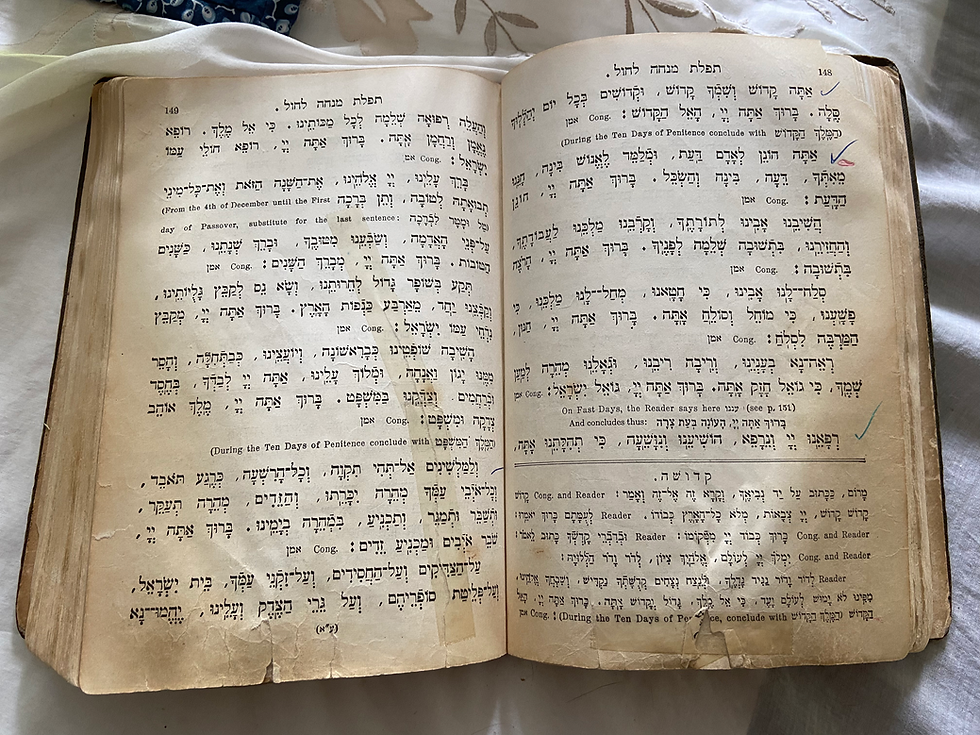
It is your siddur whose cover is worn,
with pages smooth from use.
It is hearing the murmurs of those around you as they settle into their seats.
It is your tefillin, as familiar to you as your own hands, that you remove from your ancient tefillin bag.
It is the winding the re'tzuot around your arms, an act you have done a thousand times before.
It is the familiar snugness on your head of the Shel Rosh, it is the letters woven between your fingers.
And it is that whoosh of air as you balloon the tallit around you.
and afterwards, it is that first moment
of being enveloped.
Surrounded, protected
In the presence of…
It is being the tenth,
or the first.
It is every amen you utter,
And the amens of those around you,
each amen separate as you move from blessing to blessing.
It is your hand over your eyes as you recite the Sh'ma.
It is knowing when to add yaaleh v’yavoh
When to add hallel
When not to do Tachanun.
Knowing when to stand, when to sit,
When to bow.
It is the dance of prayer as you gently sway.
It is a room full of different dances and dancers
as each ascends into their own world of words.
It is the conscious effort
To recite the words with intention,
to feel them as they rise from your breath,
exit your mouth
and create a cloud of words flying over your head,
that travel upward, like sweet smoke.
It is the sound of pages turning during the silent prayer;
the soft sounds of breathing in the room.
It is the sound of Siddurim being closed.
It is the unwinding of the tefillin and the marks they
leave on your arms for hours after praying…
A hint of the words you have just recited.
It is the goodbyes that you utter as you leave, knowing that you will repeat this all again tomorrow and tomorrow and tomorrow.
This is it.
Every day.
It's what we do.
אָמַר רֵישׁ לָקִישׁ: מַאי דִּכְתִיב ״זֹאת הַתּוֹרָה לָעֹלָה לַמִּנְחָה וְלַחַטָּאת וְלָאָשָׁם״ – כל הָעוֹסֵק בַּתּוֹרָה כְּאִילּוּ הִקְרִיב עוֹלָה, מִנְחָה, חַטָּאת, וְאָשָׁם.
§ The Gemara cites similar interpretations of verses: Reish Lakish said: What is the meaning of that which is written: “This is the law [torah] of the burnt offering, of the meal offering, and of the sin offering, and of the guilt offering, and of the consecration offering, and of the sacrifice of peace offerings” (Leviticus 7:37)? This teaches that anyone who engages in Torah study is considered as though he sacrificed a burnt offering, a meal offering, a sin offering, and a guilt offering.
Menachot 110a:5


May his memory be a blessing.